Community Connections
The Bakken Center celebrates 30 years of making community a cornerstone of the work.
October 14, 2025
Katie Dohman

Bakken Center for Spirituality & Healing Founder and Director Dr. Mary Jo Kreitzer had a big idea with a Field of Dreams philosophy when she began her work at the Center: If you build it, they will come. They being, of course, the community, for the outreach and education programming and resources that have become a cornerstone of the Bakken Center’s work, 30 years on.
“Very early on, in addition to our focus on research and academic programming, we began engaging directly with the community,” says Kreitzer. “It came from the belief that to advance health, wellbeing, and human flourishing, we had to get the public the skills, knowledge, and tools to take better charge of their own health and wellbeing. That was the impetus of creating a whole platform. Certainly, 30 years ago, we couldn’t have imagined all we are doing today.”
Spoiler alert: People came. And keep coming.
To take one example, according to Molly Manko, the Bakken Center community relations program and event manager, the Center has hosted free weekly Mindful Mondays via Zoom for more than five years. Over those years, the Center has offered more than 250 sessions, with a total registration count of more than 210,000. On their own, those numbers are impressive, but the examination of the effect of those numbers is what is really powerful. “Mindful Mondays have been a welcome break from the stresses of my job,” says Melissa Critchley, a business admin specialist, Check & Connect, in the University’s College of Education and Human Development. “It gives me a moment, in the middle of the day, to slow down, breathe, and collect myself so that I have the resilience to get through the rest of the day.”
Having that calm center in the midst of regular daily stress is one beneficial aspect, but Mindful Mondays and other programs from the Bakken Center have also impacted people in a ripple effect, in ways large and small.
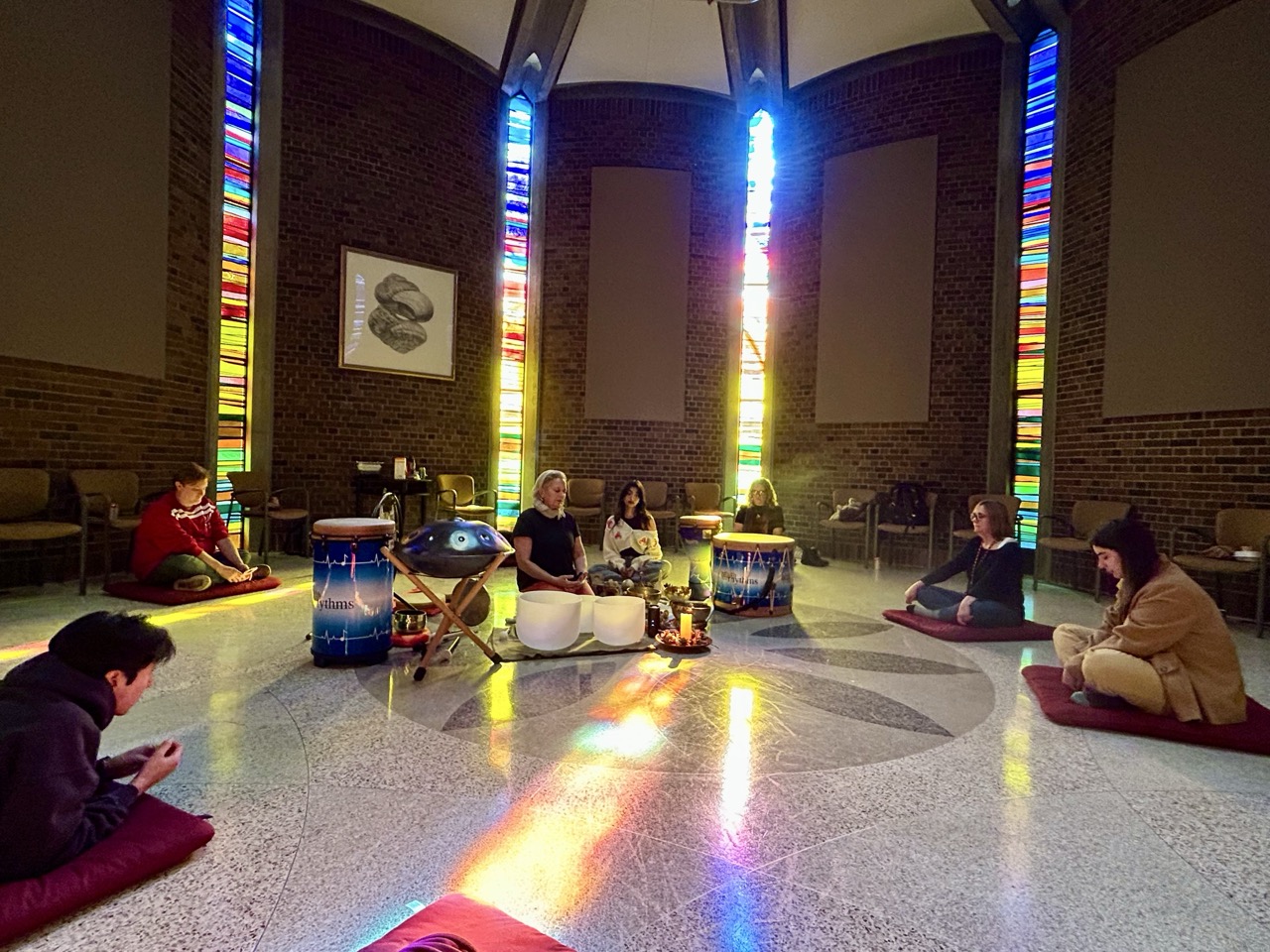
Zeynep Basgoze, a neuroimaging research scientist at the Masonic Institute for the Developing Brain (MIDB) & Psychiatry and Behavioral Sciences Department at the University, says both online and in-person mindfulness and yoga sessions, arts & wellbeing events, and other classes have been invaluable in helping her navigate some of the most overwhelming periods of her life - when she balanced dealing with multiple types of cancer, being a mother of a toddler, and managing care for her aging parents.
“These classes have provided a dedicated space for self-care, allowing me to connect with myself on a deeper level. Through them, I’ve gained greater self-awareness, which has positively impacted how I interact with others. I’ve learned to manage my reactions more thoughtfully, set healthy boundaries, and, most importantly, when I’m with them, I no longer feel judged or isolated for who I am, my feelings, or my actions,” Basgoze says. “What’s been especially powerful is the sense of belonging and the strength of community I’ve found. The Bakken Center’s events have given me the peace and support I truly need during these challenging times.”
The Bakken Center has always taken a multipronged approach to education: offering academic classes, educating healthcare professionals, and educating the public. Kreitzer says that to be successful at the third prong, you not only have to offer programming to the public, but offer the programming the public says it needs, in ways they need it.
“We’ve always been really responsive to community needs and kept our ear close to the ground in terms of really understanding what the public is needing, wanting, experiencing,” Kreitzer says. “Pre-pandemic, we had a lot of anxiety and depression and stress-reduction programs, but in the pandemic [lockdown], we were feeling such isolation, and so grief and loss became a huge topic. What we’ve consistently done is looked at what’s out there, what people are needing and wanting, and then developing programming to match.”
Offering both in-person and online programming has been an educational and wellbeing boon for participants, greatly increasing accessibility, as has the sliding scale pricing and free programming the Center is able to offer thanks to generous donors and the University’s Office of Human Resources.
Sue Nankivell, director of business development and community relations, says that increasingly, people need to be more discerning about how they spend their money, yet the need to support their wellbeing is more important than ever. “It’s been huge and meaningful to offer this programming without financial barriers,” she says, citing members of the community who may never otherwise have the resources to take part in wellbeing programming — from retirees on fixed incomes to those who are unemployed to those working multiple jobs to make ends meet.
This reach is certainly local, but it’s regional, national, and global, too. For instance, the Center’s Taking Charge of Your Wellbeing website garners millions of visitors annually. According to Molly Manko, the Bakken Center community relations program and event manager, programming this past year reached people in 85 of 87 Minnesota counties. People join locally in person and online as well.
Sharon Heron, a retired Assistant Director for Employer Relations, Career & Internship Services at the University, says the Center’s offerings, from Qigong and chair yoga to weekly guided meditations, opened new doors. “I had never tried many of these practices before, and they became a meaningful part of my routine,” she says. “The peace, grounding, and inspiration I found through your programs not only made a difference in my life, but in the lives of those around me as well.”
But no matter how much the world has changed—no matter how much the Bakken Center itself has changed—one thing remains. “I go back to our vision,” Kreitzer says. “It is really about advancing the health and wellbeing of people, organizations, and communities. How do we help people flourish? To do that, it is not enough to focus only on healthcare. We have to be focusing on the public.”